Tuckman’s Ladder: The 5 Stages of Team Development
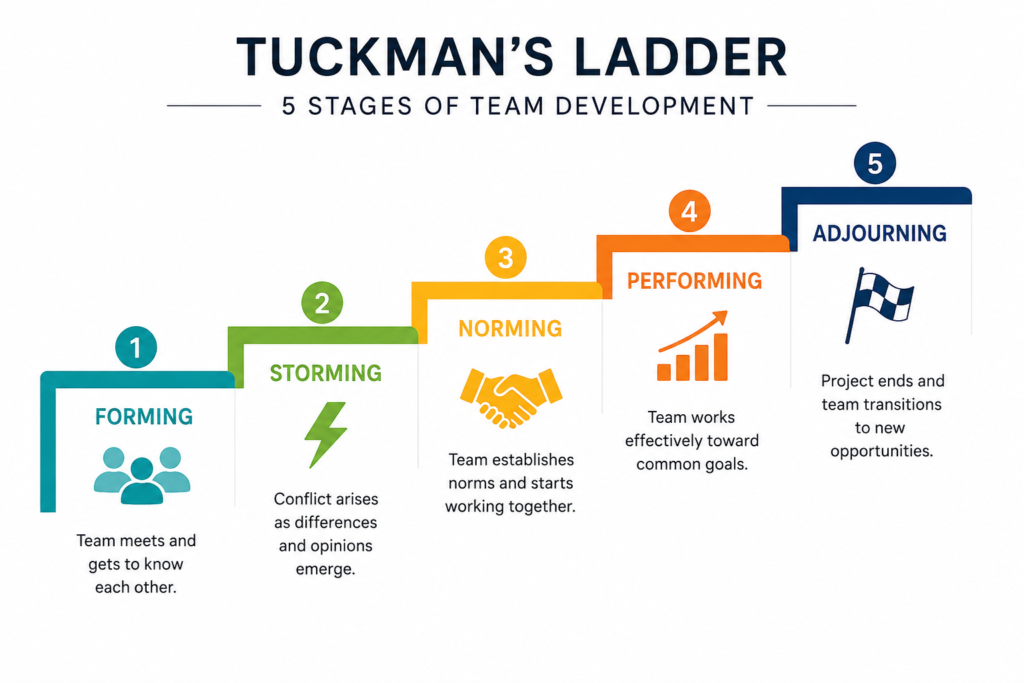
Tuckman’s Ladder is one of the most widely used models for understanding team development. It explains why teams experience conflict, uncertainty, and change before they become high-performing. Whether you are leading a project team or joining a new one, understanding Tuckman’s Ladder can help you navigate each stage more effectively. Have you ever joined a new project and thought, “This team is great. We will finish everything ahead of schedule”? Then, a few weeks later, disagreements start. Someone makes decisions without asking others. One team member disappears for days without giving updates. Another person believes they should lead an important task. Meetings become longer. Small problems become bigger problems. People stop focusing on the project and start focusing on each other. If this sounds familiar, do not worry. It does not necessarily mean your team is failing. It might simply mean your team is behaving exactly as expected. What is Tuckman’s Ladder? Understanding the Five Stages of Team Development Back in 1965, psychologist Bruce Tuckman suggested that teams go through predictable stages before they become truly effective. Years later, together with Mary Ann Jensen, he added a fifth and final stage. Today, we know this model as Tuckman’s Ladder or the Five Stages of Team Development. The stages are simple: Exhibit 1 – Tuckman’s stages of team developmentStuart, A. (2014). Ground rules for a high performing team. Paper presented at PMI® Global Congress 2014—North America, Phoenix, AZ. Newtown Square, PA: Project Management Institute. The History of Tuckman’s Ladder and Team Development Theory Tuckman’s original research examined how groups evolve over time and identified recurring patterns in team behavior. His model remains widely used in project management, organizational development, human resources, and leadership training because Tuckman’s Ladder helps explain why even talented teams experience periods of uncertainty and conflict before reaching peak performance. Let’s look at a real-world example. Imagine you are leading a process improvement project. Your team includes people from different departments and different cities. Some have ten years of experience. Others are relatively new. A few people know each other, but most have never worked together before. Why Tuckman’s Ladder Still Matters Today More than 60 years after its introduction, Tuckman’s Ladder remains one of the most widely used frameworks for understanding team dynamics. The model is based on a simple idea: every team, without exception, moves through predictable stages of development before reaching peak performance. Whether teams are co-located, remote, cross-functional, or distributed across different countries and time zones, the same patterns tend to emerge. Understanding these stages helps leaders recognize that conflict is not a sign of failure. Instead, it is often a necessary step toward stronger collaboration and better results. Tuckman’s Ladder Stage 1: Forming You organize a kickoff meeting. Everyone is polite. People talk about their backgrounds, hobbies, and previous projects. They seem motivated and excited. At this point, nobody wants conflict. Nobody wants to look difficult. Everyone is still trying to understand their place in the team. Who will make decisions? How will disagreements be handled? Who is responsible for what? This is the forming stage. Most teams look productive during this phase, but in reality, they are still getting to know each other. The real test starts when the actual work begins. Tuckman’s Ladder Stage 2: Storming A few weeks later, the project schedule is shared. Some team members feel their opinions were ignored. Two people disagree about who should lead an important workstream. One person prefers to work alone and rarely updates the rest of the team. Suddenly, the positive atmosphere from the kickoff meeting disappears. Sound familiar? This is the storming stage. Many managers think conflict is a sign that something has gone wrong. Actually, the opposite is true. Conflict usually means people care about the project enough to defend their ideas. The real problem is not disagreement itself. The problem is avoiding difficult conversations. Tuckman’s Ladder Stage 3: Norming As roles become clearer and expectations are discussed openly, something starts to change. Team members learn each other’s strengths. The senior employees begin mentoring the junior ones. People stop competing for ownership and start sharing responsibility. Instead of asking, “Who caused this problem?” they begin asking, “How can we solve it together?” This is the norming stage. Trust develops slowly. Usually, it happens after people see that their teammates keep their promises and support each other when problems appear. Tuckman’s Ladder Stage 4: Performing After several months, the team works differently. Meetings become shorter. Decisions happen faster. People ask for help without hesitation. Disagreements still happen, but they no longer turn into conflicts. The team focuses on finding solutions instead of proving who is right. This is the performing stage. Many teams never reach this level. Some remain stuck in the storming phase because they cannot move beyond personal disagreements. Others believe they are performing well simply because there is no conflict. But silence is not always a sign of harmony. Sometimes it is a sign that people have stopped sharing their opinions. Why Teams Move Backward Even high-performing teams can move backwards. A new team member joins. Project priorities change. Deadlines become tighter. Suddenly, old disagreements return. The team starts asking the same questions again. This is completely normal. Team development is rarely a straight line. Tuckman’s Ladder Stage 5: Adjourning Eventually, the project comes to an end. The deadlines are met. The customer is happy. The team members move on to different projects. There is a sense of achievement, but also a little sadness. After months of working together, people build relationships that go beyond the project itself. This final phase is called adjourning. Unfortunately, many organizations skip this stage. They jump directly to the next project without taking time to discuss lessons learned or celebrate success. That is a mistake. Teams need closure just as much as they need a good start. How Leaders Can Support Teams Through Each Stage of Tuckman’s Ladder Different stages require different leadership approaches. The most effective leaders understand that their role
Tuckman’s Ladder: The 5 Stages of Team Development Read More »