
Table of Contents
Stakeholder management can make or break a project.
Many projects run into trouble not because of technical challenges, but because expectations are unclear, priorities change, or key decisions take too long.
Among all stakeholders, sponsors often have the biggest impact on project outcomes. They can remove blockers, secure resources, and help teams move faster. However, they can also create delays, change priorities, and introduce new requirements at the last minute.
Have you ever worked on a project where everything seemed under control until the sponsor joined the meeting?
The timeline was clear. The team knew what to do. Risks were documented.
Then suddenly, priorities changed.
A new feature became urgent. A decision that should have taken two days took two weeks. Team members started receiving direct messages from senior leaders.
The project slowed down, frustration increased, and nobody understood what had changed.
If this sounds familiar, you are not alone.
Stakeholder Management Starts with Understanding the Sponsor
A project sponsor is usually the person who supports the project at the executive level.
They secure the budget, remove blockers, make important decisions, and help align the project with business goals.
At least, that is the theory.
In reality, sponsors are busy people.
They have their own targets, meetings, and priorities.
Sometimes they are highly engaged. Sometimes they disappear for weeks.
Sometimes they want weekly updates.
Sometimes they want to approve every small decision.
The challenge for project managers is simple: every sponsor is different.
Stakeholder management becomes challenging when sponsors have different communication styles, priorities, and expectations.
Stakeholder Management: What Makes a Sponsor Difficult?
Before calling someone a difficult sponsor, it helps to understand what is really happening.
Let’s look at a few common examples.
The Micromanager
This sponsor wants to know everything.
Some sponsors ask for detailed updates. Others contact team members directly or question small decisions.
Usually, this is not about control.
It is about trust.
If sponsors feel they do not have enough visibility, they naturally try to create it themselves.
The Invisible Sponsor
You send emails. No response.
You schedule meetings. They cancel.
You need a decision. Silence.
This type of sponsor creates delays because the team cannot move forward without direction.
The Scope Expander
Every meeting brings a new request.
“Can we add this feature?”
“Can we include this team?”
“Can we launch one month earlier?”
Of course, everything is a priority.
The problem is not the new ideas.
The problem is adding new work without discussing the impact.
If you have managed projects long enough, you have probably experienced something similar.
A few years ago, I was managing a website redesign project.
We had completed the discovery workshops, aligned on the scope, and agreed on the timeline. The design team had already started working on the wireframes, and the development backlog was taking shape.
Everything seemed to be moving in the right direction.
A few weeks later, one of the managing partners (project sponsor) attended an industry event.
The next morning, I received a message.
They had seen several features on a competitor’s website and wanted to include similar functionality in our project.
There was just one problem.
The launch date could not change.
The budget could not increase.
The team size would stay the same.
The expectation was simple:
“Let’s add these features before go-live.”
At first, saying yes feels like the easiest option. After all, the request comes from the sponsor. However, saying yes too quickly creates bigger problems later.
Every additional request affects something else.
Maybe the timeline changes.
Maybe the budget increases.
Maybe the team works extra hours.
Maybe quality suffers because testing time is reduced.
There is always a trade-off.
That experience taught me an important lesson.
As project managers, our role is not to reject new ideas or protect the original plan at all costs.
Our job is to make the impact of decisions visible.
Instead of saying, “We can’t do it,” I prefer asking a different question:
“What are we willing to change to make this possible?”
The Firefighter
Some sponsors only pay attention when there is a crisis.
If everything is going well, they are absent.
When something goes wrong, they want daily updates and immediate action.
This creates a reactive environment where the team is always solving today’s problem instead of preparing for tomorrow’s.
Stop Managing Tasks, Start Managing Expectations.
Projects and operations require different communication approaches. Sponsors often struggle when operational thinking influences project decisions.
One of the biggest mistakes project managers make is focusing only on delivery.
Stakeholder management is expectation management.
Sponsors do not need every project detail.
They need answers to simple questions:
- Are we on track?
- What risks should I know about?
- What decisions do you need from me?
- What happens if we change direction?
If you answer these questions regularly, most stakeholder issues become easier to manage.
Good stakeholder management means sharing important information early, even when you do not have all the answers.
Stakeholder Management Framework
Not all stakeholders need the same level of attention.
One of the most useful tools I have used is a simple power-interest matrix.
Ask yourself two questions:
- How much influence does this stakeholder have?
- How interested are they in the project?
Based on the answers, stakeholders usually fall into four groups:
- High power, high interest: manage closely
- High power, low interest: keep satisfied
- Low power, high interest: keep informed
- Low power, low interest: monitor occasionally
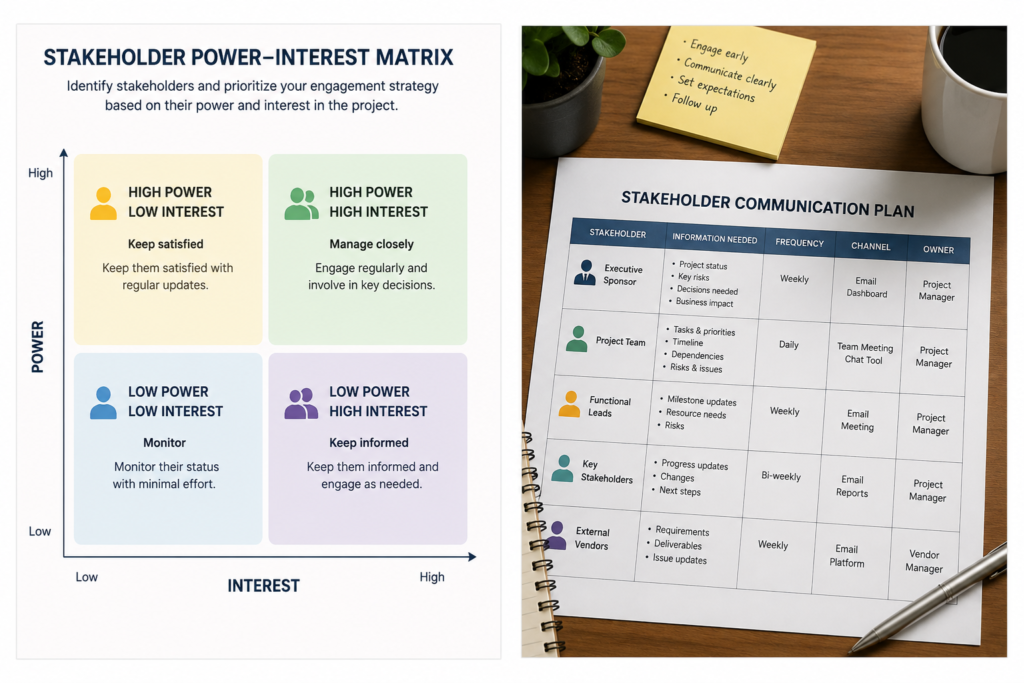
Once you identify these groups, create a simple communication plan.
For each stakeholder, define:
- What information they need
- How often they need updates
- Which communication channel works best
- Who is responsible for communication
A sponsor may need a short weekly update focused on risks and decisions.
Team members, on the other hand, usually need more detailed information about priorities, deadlines, and dependencies.
The goal of stakeholder management is not to communicate more.
It is to communicate the right information to the right people at the right time.
Avoid Surprises: Stakeholder Management Requires Early Communication
Bad news does not destroy trust.
Unexpected bad news does.
Sponsors understand that projects face challenges. However, they dislike hearing about those challenges too late.
When an issue appears, communicate early.
You do not need to have all the answers.
A simple structure works well:
- What happened?
- Why does it matter?
- What are the options?
- What do you recommend?
This approach keeps discussions focused on solutions instead of blame.
Use Data Instead of Opinions
Imagine telling your sponsor:
“The team is overwhelmed.”
That statement creates emotion, not action.
Now compare it with this:
“The team is currently working at 120% capacity. Adding two new features will delay the launch by three weeks.”
Which message is easier to understand?
Which one is easier to act on?
In fact, data removes assumptions and turns difficult conversations into business discussions.
Whenever possible, use:
- Resource capacity
- Budget impact
- Timeline changes
- Risk exposure
- Dependencies
Facts reduce conflict.
Clarify Decision Ownership
Many projects slow down because nobody knows who should make decisions.
Ask these questions early:
- Which decisions can the team make independently?
- Which decisions require sponsor approval?
- How quickly should decisions be made?
- When should issues be escalated?
Clear governance saves time.
Without it, every small issue becomes an executive discussion.
Learn to Say “Yes, If…”
We are as project managers sometimes think we have only two options.
Yes or no.
In reality, there is a third option.
Trade-offs.
Instead of saying:
“We cannot do that.”
Try this:
“Yes, we can add this feature. To do that, we need to extend the timeline by two weeks or increase the budget. Which option works best?”
This changes the conversation completely. The sponsor still owns the decision. You simply make the consequences visible.
You Cannot Control Stakeholders
You cannot control stakeholders.
You cannot control their priorities, workloads, or management styles.
What you can control is how you communicate.
You can create clarity.
You can provide visibility.
You can remove surprises.
You can make decisions easier.
Most importantly, you can build trust.
Difficult sponsors rarely become easier overnight. However, strong communication often turns difficult relationships into productive ones.
In the end, stakeholder management is not about controlling people. It is about building trust, creating clarity, and helping teams make better decisions.
Whether you work in Agile, Waterfall, or hybrid environments, stakeholder management remains one of the most important project management skills.